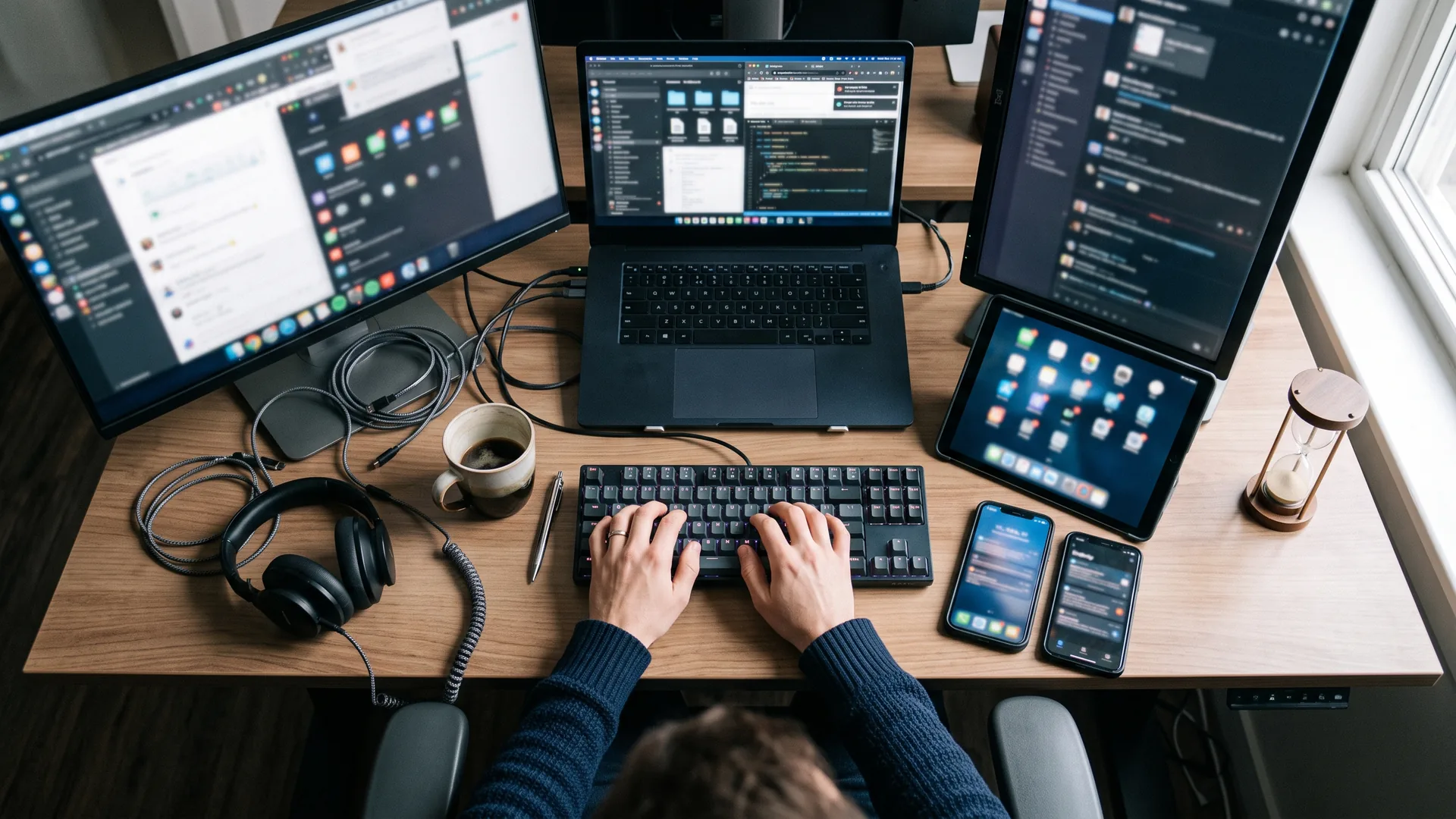
There is a small device, available for about ten dollars, whose only purpose is to keep a status light green. It nudges the mouse every few minutes so the worker at the other end appears to be at their desk. Its existence is not a story about lazy employees. It is a story about a broken metric, and the fact that a market exists for it tells you the metric is being gamed at scale.
Digital presenteeism, the pressure to look switched-on, has graduated from a remote-work grumble to a named entry on 2026 workplace-wellbeing trend lists.1 The green 'active' dot in Slack and Teams has become a proxy managers use to track effort, and the dot can be held green for the price of a sandwich.2 When the only thing a tool can legibly see is availability, availability is what people will produce.
The metric manufactures the behaviour
This is the part worth being precise about, because it is causal rather than incidental. The conditions that breed presence theatre are structural. Some 78 per cent of employers now monitor in some form, while only 22 per cent of employees know they are watched online, and covert monitoring carries 2.3 times the quit intent of the transparent kind.3 People are not faking work because they are idle. They are optimising for the only signal the system can read.
What separates monitoring that helps from monitoring that backfires is framing, not technology. Gartner finds that transparent monitoring can lift performance by up to 22 per cent, while covert monitoring that employees later discover drops trust by 34 per cent. The same tool produces opposite outcomes depending on whether people understand it.4 A Harvard Business School field study draws the line from the other direction: monitoring used to develop people improves performance, while monitoring used to control them increases the counterproductive behaviour it was meant to catch, the mouse-jiggling included. Roughly a quarter of monitored employees admit to simulating activity.5
Where the devices came from, and the arms race that followed
The market did not appear because people got lazier in 2020. It appeared because a measurement problem was handed to managers who had no instrument for it. Microsoft's 2022 pulse research put the gap in numbers: 87 per cent of employees reported being productive, while 85 per cent of leaders said the shift to hybrid work had made it challenging to have confidence that their people were.6 Something had to close that gap, and the only thing every tool could already see was whether somebody was at the keyboard. The green dot was promoted from a presence indicator to a performance proxy, by default rather than by decision.
Once a proxy carries consequences, defeating it carries value. In May 2024 Wells Fargo dismissed more than a dozen staff from its wealth and investment management division, with disclosures to the Financial Industry Regulatory Authority citing "simulation of keyboard activity creating impression of active work".7 That is the moment the jiggler stopped being a novelty purchase and became a documented category of dismissal, and the moment vendors acquired a reason to sell detection.
What follows is an arms race, and its rounds are worth setting out, because the shape of the sequence is the argument. Detection started with what crosses the software boundary: inventories of installed applications and running processes, application allow-listing, and, on Windows, the fact that synthetic input generated through the SendInput API carries an "injected" marker a monitoring agent can read.8 So the devices moved into hardware, where a dongle costing a few pounds presents to the operating system as an ordinary USB human interface device. Security vendors are blunt about the gap this opens: endpoint detection and mobile device management tools are built around software behaviour, and a jiggler that looks like a mouse may not be reliably detected by them at all.9 Detection moved again, into statistics and circumstance: the timing signature of a microcontroller emitting movement at fixed intervals with almost no variance, screenshots showing hours of "active" input against a frozen screen, and the operating system's own record of every USB device ever attached.8 The devices answered with randomised paths and randomised intervals. Every round costs the employer money and adds intrusion, and not one round of it produces any information about whether the work was any good.
It is worse than a stalemate, because the escalation has a victim who was never playing. The detection guidance concedes the problem itself: legitimate setups produce input that looks synthetic, because remote desktop and virtual desktop sessions relay keystrokes and mouse events with artificial timing, and accessibility software generates programmatic clicks by design.8 Tighten the threshold far enough to catch a randomised dongle and the first people it catches are the ones working through VDI and the ones using assistive technology. An arms race over a proxy does not merely fail to buy signal. It buys false accusations, and aims them at the people least able to absorb one.
Which is what digital presenteeism and its twin, activity theatre, actually are. Not a moral failure that arrived with remote work, but the wake left behind by measuring the wrong thing and then spending real money defending the measurement.
The cruel inversion, and the way out
The deeper problem is that presence theatre punishes the work organisations claim to want. The employee who thinks for ninety minutes and types for ten looks idle on an activity feed; the one who churns visibly looks productive. The metric rewards the second and penalises the first, which is the reverse of what any knowledge business says it values. Even managers half-know this. Around 68 per cent of them believe monitoring improves work, while 72 per cent of workers say it does nothing or makes things worse.10 When the measured and the measurers disagree that sharply, the instrument is the thing in question.
The cost is not only output. Performing availability is tiring, and it drives people out: close to half say they would consider quitting if monitoring increased.5 The contrast runs the other way too, with high-trust workplaces showing 74 per cent less stress, 50 per cent higher productivity, and 40 per cent less burnout.5 A workforce spending its energy on looking busy is a workforce with less of it left for the work.
It would be easy to read all this as 'surveillance is bad' and stop there, which misses the more useful point. Two fair objections survive the argument. Transparent monitoring genuinely does improve outcomes, so part of the problem is bad implementation;34 and some roles, in support or on-call work, legitimately need responsiveness, where an always-on signal is operational rather than performative.2 Grant both. But transparency repairs the trust damage without changing what an activity metric can see. A perfectly transparent green dot is still a green dot, and it still rewards presence over thought. Stricter enforcement of a flawed unit is not the fix. A different unit is: aggregate workstyle patterns, the shape of focus and collaboration, that correlate with output and that no individual can stage. Change what you measure and there is no dot to perform, and the mouse jiggler becomes a museum piece.
Which leaves a usefully blunt test for any leader confident in their numbers. If your best people would quietly buy a mouse jiggler to satisfy your dashboard, what is your dashboard actually measuring?
Footnotes
-
Stretching the City. (2026). From AI to on-demand learning: 10 workplace wellbeing trends for 2026. https://stretchingthecity.com/blog/workplace-wellbeing-trends-2026/ ↩
-
Twist (Doist). (2025). Our obsession with measuring worker productivity is killing it. https://async.twist.com/remote-employee-surveillance ↩ ↩2
-
WorkTime. (2026). 50+ employee monitoring statistics & data in 2026. https://www.worktime.com/blog/statistics/employee-monitoring-statistics-data ↩ ↩2
-
eMonitor. (2026). Employee monitoring best practices. https://www.employee-monitoring.net/resources/employee-monitoring-best-practices ↩ ↩2
-
eMonitor. (2026). Employee monitoring vs engagement: research synthesis 2026. https://www.employee-monitoring.net/resources/employee-monitoring-vs-engagement-correlation ↩ ↩2 ↩3
-
Microsoft WorkLab. (2022). Why managers and employees can't agree on how much work is getting done. https://www.microsoft.com/en-us/worklab/why-managers-and-employees-cant-agree-on-how-much-work-is-getting-done ↩
-
CBS News. (2024). Wells Fargo fires workers after allegedly catching them simulating keyboard activity. https://www.cbsnews.com/news/wells-fargo-fires-employees-faking-work/ ↩
-
SCREENish. (n.d.). Can employers detect mouse jigglers? https://www.screenish.com/blog/can-employers-detect-mouse-jigglers ↩ ↩2 ↩3
-
Sepio. (n.d.). What is a mouse jiggler? https://sepiocyber.com/blog/mouse-jigglers ↩
-
Apploye. (2026). Employee monitoring statistics: shocking trends in 2026. https://apploye.com/blog/employee-monitoring-statistics ↩