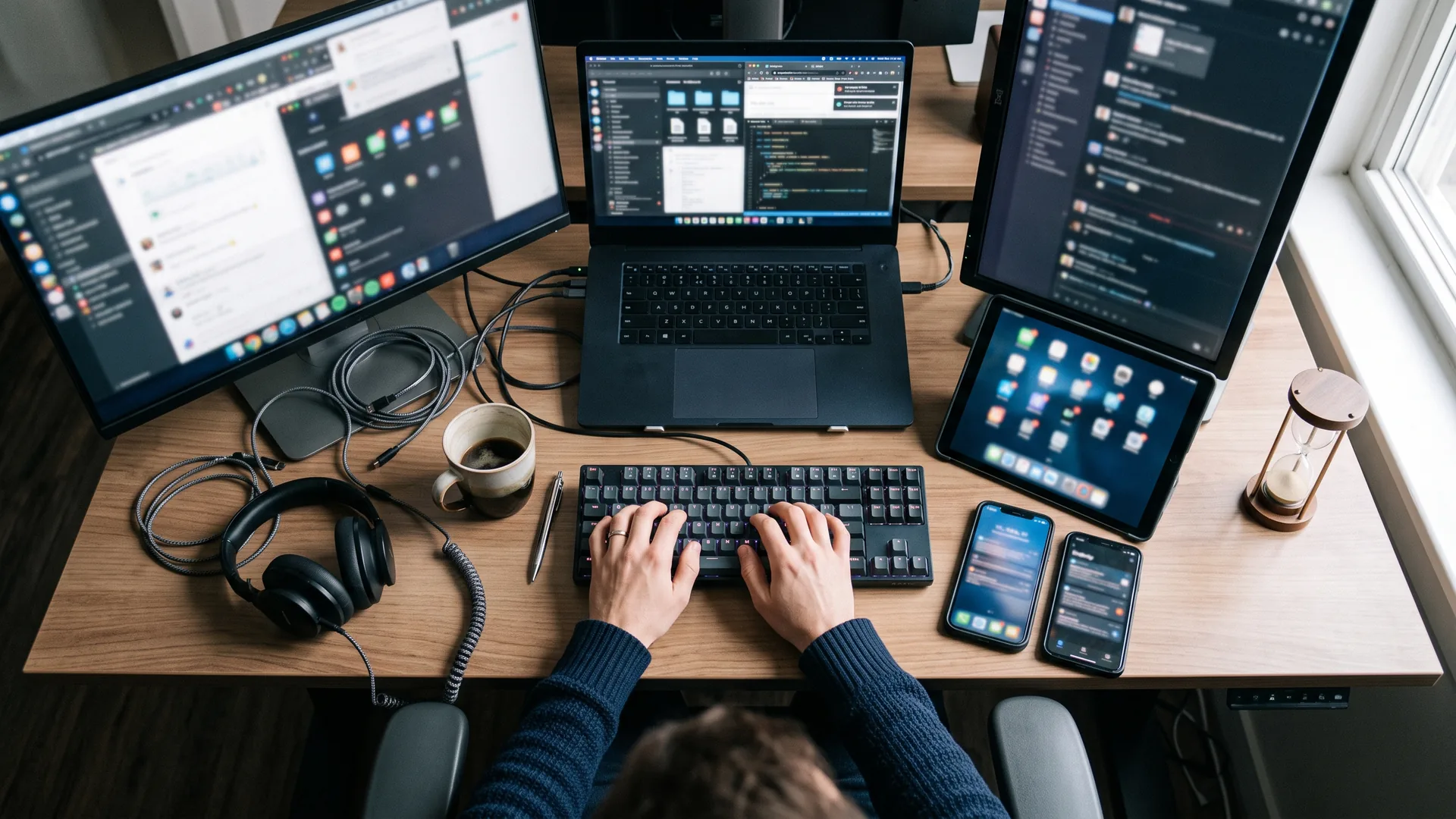
AI was supposed to hand knowledge workers their attention back. The largest behavioural datasets assembled since its arrival suggest the opposite has happened. After adopting AI, employees' average daily focused time fell by about 23 minutes, and the typical focused session shrank 9%, from 14 minutes 23 seconds to 13 minutes 7 seconds between 2023 and 2025.12 Focus efficiency dropped to a three-year low of 60%.2 A tool sold as a way to think more, and people thinking in shorter and shorter bursts.
Not because AI does nothing. Because it amplifies the day rather than emptying it. ActivTrak's analysis found that after adoption, time spent across job responsibilities rose between 27% and 346%, email volume climbed 104%, and chat and messaging surged 145%, while the length of merely productive sessions grew 13%.1 The day got faster and denser, not lighter. The researchers call the state amplified work: throughput rises while the underlying cognitive load stays where it was.1 Sustained focus fractures under exactly that condition.
The villain is the tool count, not the tool
One finding in the literature is more actionable than the rest. Boston Consulting Group's research, reported in Fortune, found that self-reported productivity rises as workers add AI tools, but only to a point: those using three or fewer reported improved efficiency, while it fell away for those running four or more.3 Gains build to roughly three simultaneous tools, then reverse.4 So the question stops being whether AI is good or bad. It becomes how many systems each role is being asked to supervise at once.
BCG also gave the cost a name. About 14% of AI-using workers reported AI brain fry: mental fog and slower decisions, a strain the researchers separate from burnout because it comes from the unusual load of supervising AI and judging its output rather than from emotional exhaustion.4 The affected group is not evenly spread; rates run higher in marketing, HR, operations and software engineering than in legal or compliance.4 And because brain fry tracks with errors and the intention to leave, the damage shows up in output quality and retention, not just morale.4
Why is fragmentation so destructive when each interruption seems trivial? Gloria Mark's controlled study established that interrupted work gets done faster, but at the price of more stress, frustration and effort.5 Sophie Leroy's attention residue supplies the mechanism: when you switch tasks, part of your attention stays behind on the unfinished one, quietly consuming the capacity the next task needs.6 Every extra AI tool brings its own residue, which is why a thirteen-minute session rarely reaches the depth real knowledge work demands.
The number nobody is netting
None of this means AI fails.
The task-level gains are real and well measured. St. Louis Fed analysis estimates weekly generative-AI users save about 5.4% of their work hours, and randomised trials show concrete narrow-task wins: roughly 14% more issues resolved in customer support, about 26% more weekly pull requests with GitHub Copilot, and around 40% faster professional writing.7 An honest account of AI productivity has to keep these in view.
The trouble is that the gains and the costs sit on different ledgers, and usually only one ledger gets kept. Take the objection at full strength: if AI genuinely speeds work, a shorter focused session might mean the same output in less time rather than worse thinking. That holds for narrow, well-structured tasks. It holds far less for deep, novel work, which is exactly where fragmentation does the most harm. Self-report also flatters the technology. A METR randomised trial found experienced developers were 19% slower when allowed AI tools, even though they believed it had sped them up by about 20%.8 Perceived productivity and measured productivity have come apart, which is why intuition is a poor guide here.
So AI carries a task-speed credit and a focus-cost debit, and most organisations record only the credit. ActivTrak found that adoption has reached roughly 80% of employees while its impact goes largely unmeasured, a blind spot it calls the AI measurement gap.1 Application-level analytics can report which tools people open and for how long. What they cannot tell a leader is whether an AI rollout is protecting deep focus or quietly dissolving it. Closing that gap takes an instrument that measures focus itself, before and after adoption, by role.
The practical step is unglamorous: cap the number of tools a role runs at once, watch focus time across the change rather than guessing, and find the band where AI helps without shredding the day. The harder step is cultural, to stop treating speed as the whole of the story. If you can measure only one side of the ledger, which side have you chosen to see?
Footnotes
-
ActivTrak Productivity Lab. (2026). 2026 State of the workplace: AI adoption & workforce performance benchmarks [As reported by J. Barth]. HR Executive. https://hrexecutive.com/focus-time-hit-a-three-year-low-the-hidden-costs-of-your-workplace-ai-rollout ↩ ↩2 ↩3 ↩4
-
Riganese, F. (2026). Workplace distraction statistics 2026: Productivity and focus rates. Makerstations. https://www.makerstations.io/workplace-distraction-statistics ↩ ↩2
-
Burleigh, E. (2026, March 13). AI promised supreme productivity, but it's actually straining workloads for employees. Fortune. https://fortune.com/2026/03/13/ai-isnt-reducing-workloads-its-straining-employees-time-spent-emailing-doubled-deep-focus-work-fell/ ↩
-
Bedard, J., Kropp, M., et al. (2026, March). The hidden cost of AI: "Brain fry" [BCG Henderson Institute research]. Harvard Business Review [as reported by Business Insider]. https://www.businessinsider.com/ai-brain-fry-bcg-consulting-exhaustion-agents-work-2026-3 ↩ ↩2 ↩3 ↩4
-
Mark, G., Gudith, D., & Klocke, U. (2008). The cost of interrupted work: More speed and stress. Proceedings of the SIGCHI Conference on Human Factors in Computing Systems (CHI '08), 107–110. https://ics.uci.edu/~gmark/chi08-mark.pdf ↩
-
Leroy, S. (2009). Why is it so hard to do my work? The challenge of attention residue when switching between work tasks. Organizational Behavior and Human Decision Processes, 109(2), 168–181 [as cited in SVA Consulting, 2026]. https://consulting.sva.com/insights/ai-brain-fry-the-productivity-cost-nobodys-measuring ↩
-
Quality Digest. (2026, June 3). AI's productivity is finally hitting the real economy. Quality Digest. https://www.qualitydigest.com/inside/improvement-tools-article/ais-productivity-finally-hitting-real-economy-060326.html ↩
-
Imas, A. (2025). What is the impact of AI on productivity? [Discussion of Becker, Rush, Barnes & Rein (METR, 2025)]. Substack. https://aleximas.substack.com/p/what-is-the-impact-of-ai-on-productivity ↩