Most workforce analytics programmes fail at the same point: the moment employees realise the dashboard is for someone else.
The instinct to monitor knowledge work is old; the technology to do it has become unusually cheap. Passive sensing, application telemetry, calendar exhaust, ambient audio: the building blocks are commodity. A recent academic survey of passive sensing in the workplace catalogued the technical maturity and reached a less comfortable conclusion: trust and consent are the binding constraints on adoption, not signal quality.1
This is the gap that almost every vendor in the category is now arguing about. Stripped of the marketing language, the disagreement is about who the data is for.
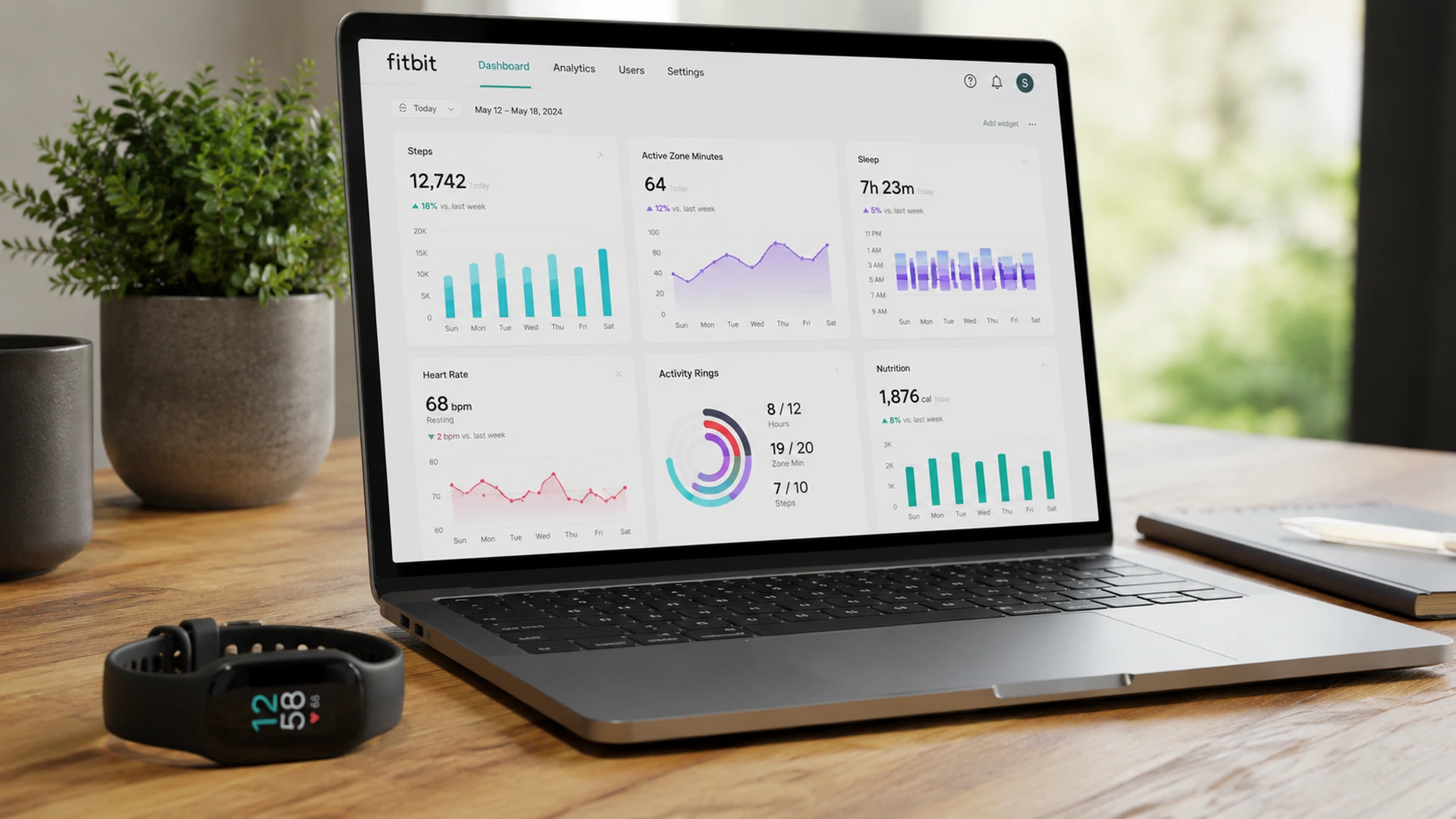
The instructive comparison sits on a wrist. Nobody who buys a Fitbit objects to wearing it. The device watches its owner constantly, takes a continuous stream of intimate biometric readings, and surfaces them in a personal dashboard. The same data, collected silently and routed to an employer, would feel like surveillance. The technology is identical. The experience is the inverse.
The workforce analytics market has spent five years insisting the difference does not matter, and the past two quietly discovering that it does. Adoption stalls when employees cannot see their own data. Self-reporting deteriorates. Sensors get switched off, browsers get partitioned, the most engaged contributors quietly route around the system. The output is data, but it is data of the wrong kind: defensive, sparse, and skewed towards the indifferent.
The architecture is the argument
The temptation is to treat employee-visible dashboards as a feature, slotted in alongside heatmaps and benchmarking. They are not features. Employee visibility is an architectural commitment, and the commitments that sit around it are what determine whether the resulting data is worth analysing.
Consider what genuine trust requires. Raw signals like keystrokes, application focus, and screen content should never leave the device unless the employee has explicit reason to send them. Aggregations should be defined transparently. The dashboard the employee sees should not be a watered-down version of the employer's view; the two should be the same view, with the employer seeing a population and the employee seeing themselves.
These commitments are difficult to retrofit. A platform built around screenshot capture and central log ingestion does not become employee-first by adding a self-service screen. The retrofit produces a sanitised front-end attached to a surveillance back-end, and employees can tell.
This is where the Fitbit analogy stops being decorative. The product worked because the design started with the wearer. The data was theirs, the interpretation was theirs, and the decision about what to share was theirs. The aggregate health insights that emerged later were a by-product of a tool people used willingly, not the original asset.
Why trust-based design is also commercially better
The standard objection is that an employee-first architecture sacrifices analytical rigour. The evidence now points the other way. Wellhub's 2026 corporate wellness analysis found that organisations running comprehensive, trust-based wellbeing programmes saw returns of 150% or more, comfortably ahead of compliance-driven peers.2 Conference agendas in people analytics have converged on the same theme; the phrase increasingly used in panel titles is "experience measurement without surveillance vibes."3
The mechanism is unglamorous. Trusted instruments collect cleaner data because the people being measured are not actively defending against the measurement. A workforce that volunteers context — a flagged focus block, a labelled meeting, a noted handover — produces signals that no amount of inferred telemetry can match.
The argument has been framed for years as ethics versus efficacy, with the implicit suggestion that respecting employees costs something in the analytical output. The harder lesson is that the costs run the other way. Surveillance-first systems pay an analytical tax: guarded behaviour, gamed signals, brittle adoption, and a slow attritional erosion of the very trust that makes longitudinal measurement possible at all.
The competitive moat nobody is naming
For vendors entering the category late, the temptation will be to layer employee-experience features onto existing surveillance-grade platforms. The layering will not hold. Data architecture built around the assumption that the employer is the only legitimate user is closer to a rebuild than a refactor when the assumption changes. Vendors that started in the other direction enjoy a moat that does not show up in any feature matrix.
For employers choosing tools, the question to ask is simple, and unflattering when answered honestly. If the employee dashboard were removed tomorrow, would the system still function as designed? If yes, the system was never built for the employee. The dashboard is decoration.
The workforce analytics category is mid-way through a quiet inversion. The vendors that defined the first wave assumed the employer was the customer and the employee was the subject. The vendors building the second wave are beginning to suspect that those two roles, in any system worth keeping, have to overlap. The question for buyers in 2026 is whether the people generating the data would willingly turn it on if they had the choice.
Sources
Footnotes
-
A Survey of Passive Sensing in the Workplace, arXiv preprint, 2024. https://arxiv.org/html/2201.03074v3 ↩
-
Corporate Wellness Trends HR Must Know for 2026, Wellhub, 2026. https://wellhub.com/en-us/blog/wellness-and-benefits-programs/corporate-wellness-trends/ ↩
-
10 Best People Analytics Conferences 2026, RecruitersLineup, 2026. https://www.recruiterslineup.com/best-people-analytics-conferences-to-learn/ ↩