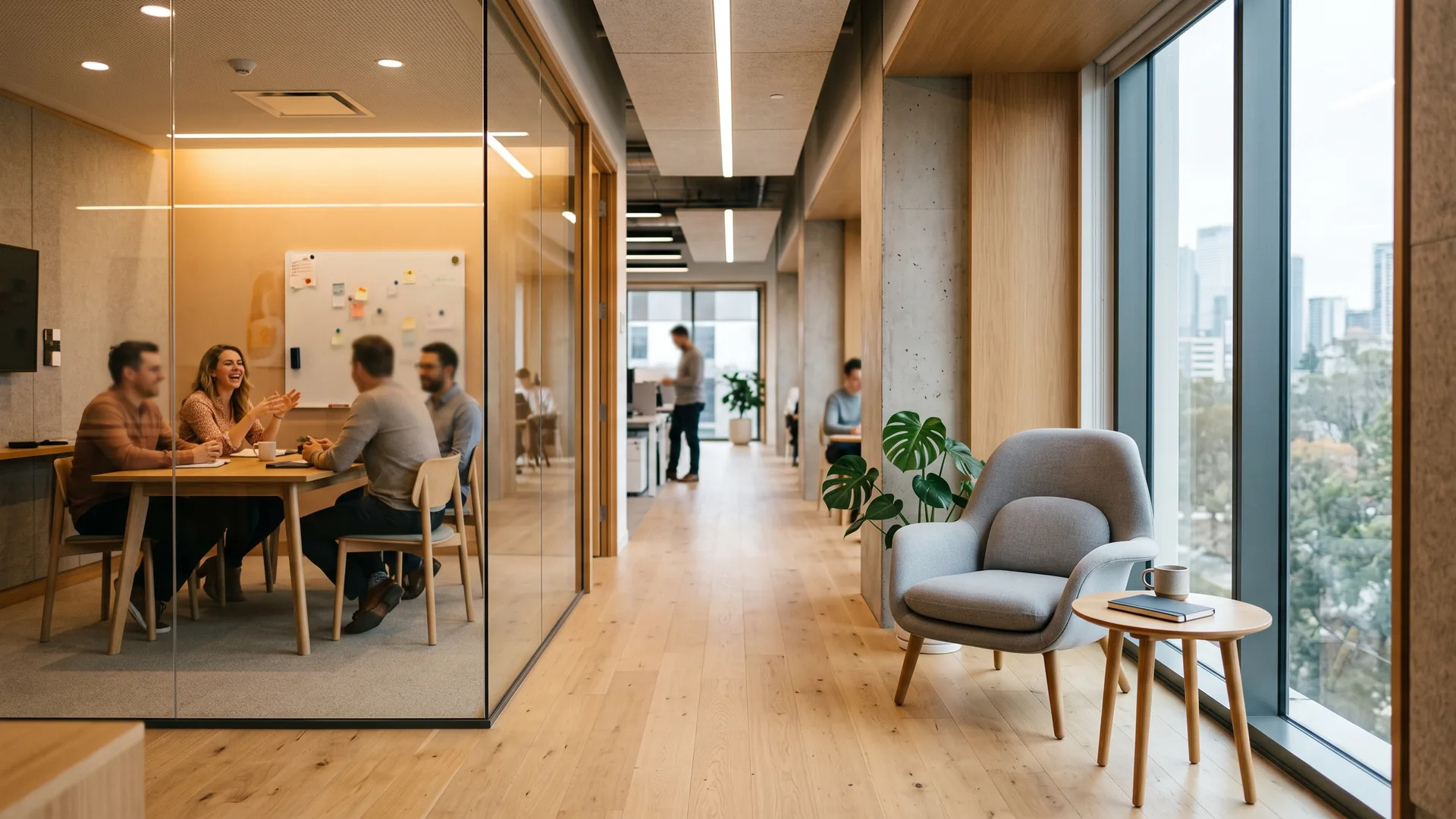
The return-to-office debate has hardened into a standoff over where people sit. In the process it has lost sight of the outcome both camps claim to want: time to think. On that measure, the supposed compromise performs worst of all. Benchmark tracking data puts hybrid teams at just 31% of their working hours in uninterrupted deep focus, below fully in-office teams at 45% and fully remote teams at 41%.12 The arrangement most knowledge workers now use, and the one sold as the best of both worlds, is on the focus dimension the worst of one.
The instinct is to read that as an argument about location. It is not. The cause is the toggle between home and office, not the split itself, paired with schedules so poorly coordinated that the week fragments. When colleagues come in on different days, an organisation pays the full commute and meeting cost and captures little of the collaboration benefit, while remote days fill with the async overflow the office days could not hold.2 This is why the question can sidestep the politics of presence: the lever is design, not address.
The interruption load the calendar never shows
The macro statistic has a micro mechanism. Gloria Mark's research at UC Irvine finds knowledge workers switch tasks roughly every three minutes, hit a significant interruption about every eleven, and need an average of 23 minutes and 15 seconds to return fully to the original task.3 Multiply the contexts a hybrid worker has to hold, and each costly transition multiplies with them.
Microsoft's telemetry shows how relentless the load has become. Across aggregated Microsoft 365 signals, employees are interrupted every two minutes during core hours, about 275 times a day, with after-hours chats up 15% year on year and 60% of meetings called ad hoc rather than scheduled.4 Nearly half of employees (48%) and more than half of leaders (52%) describe their work as chaotic and fragmented.5 Sixty-eight percent say they do not have enough uninterrupted focus time, and the average employee now spends 57% of their app time communicating against just 43% creating.6 The balance of the knowledge-work day has tilted toward coordination and away from production, and much of what fragments an office day, the ad hoc huddle, the last-minute deck edit, never appears on a calendar at all.
The remote advantage, by contrast, holds up under objective measurement rather than self-report. Using platform tracking, remote workers log about 4.55 hours of daily focus against 3.72 for in-office staff, and remote arrangements protect roughly 62 hours a year that office teams lose to interruptions.7 The point for a leader is not that remote wins. It is that the differences between arrangements are real and measurable, which makes them designable.
Designing the week for focus, not presence
Before redesigning anything, grant the strongest objection. Focus hours are a means, not an end. Most knowledge work is collaborative, calendars are shared rather than personal, and one excellent hour of deep work beats four mediocre ones.8 By that logic an arrangement scoring lower on raw focus might still produce more value through richer collaboration, and deep focus on remote days can come at the cost of being reachable.9 All true. But it reframes the problem rather than dissolving it. Hybrid's failure is not too little collaboration; it is mistimed collaboration, with office days buried under low-value meetings and remote days eroded by overflow. The aim is not to maximise focus hours blindly but to put collaboration and focus where each belongs.
What does that look like in practice? A typical hybrid week loads anchor days with back-to-back status meetings, then lets the deep work scatter across remote days that fill with messages anyway. A focus-first week inverts the logic: it concentrates genuine collaboration, the workshops and decisions that need a room, on the days people are together, and defends the remote days as protected blocks for the work that needs silence. Same two locations, opposite outcome.
Practitioner benchmarks give the redesign numbers to aim at: keep meeting load at or below 15 hours a week, protect at least 20 hours of focus time, and hold meetings under 30% of the working week.10 These turn "more focus" from an aspiration into an operating target a team can track. The evidence also points to the lever that makes a redesign stick. A global hybrid study found that trust between colleagues, not mandated presence, is the single most effective way to overcome hybrid communication barriers, and that people want the office as a collaboration hub rather than a compulsory desk.9
That matters because the blunt instrument, the anchor-day mandate, often works against focus. Forcing everyone in on the same days tends to generate more meetings and messages, loading the office day with exactly the interruption density that destroys deep work. Co-location without intent simply relocates the fragmentation.
The way through is to measure focus where it is actually lost. Track focus time and meeting density by day-type, anchor versus remote, and the picture stops being a guess. A leader can then see whether Tuesday's mandate bought collaboration or just filled calendars, and make a surgical fix instead of a blanket rule. The surveillance route corrupts this data the moment it arrives, because watched employees perform busyness rather than work; analytics the employee owns and reads first stays honest, and turns people into advocates for better meeting hygiene rather than its subjects.
The RTO debate asks where people should sit. The quieter and more useful question is which hours of your team's week are actually built for thinking and which only look like work — and that one the data can finally answer.
Footnotes
-
Hubstaff. (2026). 2026 Global Trends & Benchmarks: How Work Gets Done. Hubstaff. https://hubstaff.com/global-work-report ↩
-
Gable. (2026). 40+ hybrid work statistics that define 2026. Gable Blog. https://www.gable.to/blog/post/hybrid-work-statistics ↩ ↩2
-
Mark, G., Gudith, D., & Klocke, U. (2008). The cost of interrupted work: More speed and stress. Proceedings of the SIGCHI Conference on Human Factors in Computing Systems (via Super Productivity, 2025). https://super-productivity.com/blog/context-switching-costs-for-developers ↩
-
Microsoft. (2025). 2025 Work Trend Index Annual Report: Will AI fix work? Microsoft WorkLab. https://assets-c4akfrf5b4d3f4b7.z01.azurefd.net/assets/2025/04/2025_Work_Trend_Index_Annual_Report_680aaa7fe52dd.pdf ↩
-
Microsoft. (2025). Breaking down the infinite workday (Work Trend Index Special Report). Microsoft WorkLab. https://www.microsoft.com/en-us/worklab/work-trend-index/breaking-down-infinite-workday ↩
-
Microsoft. (2025). Will AI fix work? Work Trend Index. Microsoft WorkLab. https://www.microsoft.com/en-us/worklab/work-trend-index/will-ai-fix-work ↩
-
Hubstaff. (2024). Remote workers engage in deeper work with fewer interruptions, says Hubstaff data. Hubstaff Blog. https://hubstaff.com/blog/remote-work-deeper-focus-fewer-interruptions-study ↩
-
Rivva. (2025). Why deep work is nearly impossible in modern work environments (and what actually works). Rivva Blog. https://blog.rivva.app/p/why-deep-work-is-nearly-impossible-in-modern-work ↩
-
Reworked. (2025). The hybrid employee experience in 2025: findings from a global study. Reworked. https://www.reworked.co/digital-workplace/the-hybrid-employee-experience-in-2025-findings-from-a-global-study/ ↩ ↩2
-
Worklytics. (2025). How to measure employee performance in hybrid work environments: Q3 2025 guide. Worklytics Resources. https://www.worklytics.co/resources/how-to-measure-employee-performance-hybrid-work-environments-q3-2025-guide ↩